
Why Your Setting Spray Leaves Large Droplets and How to Test the Pump
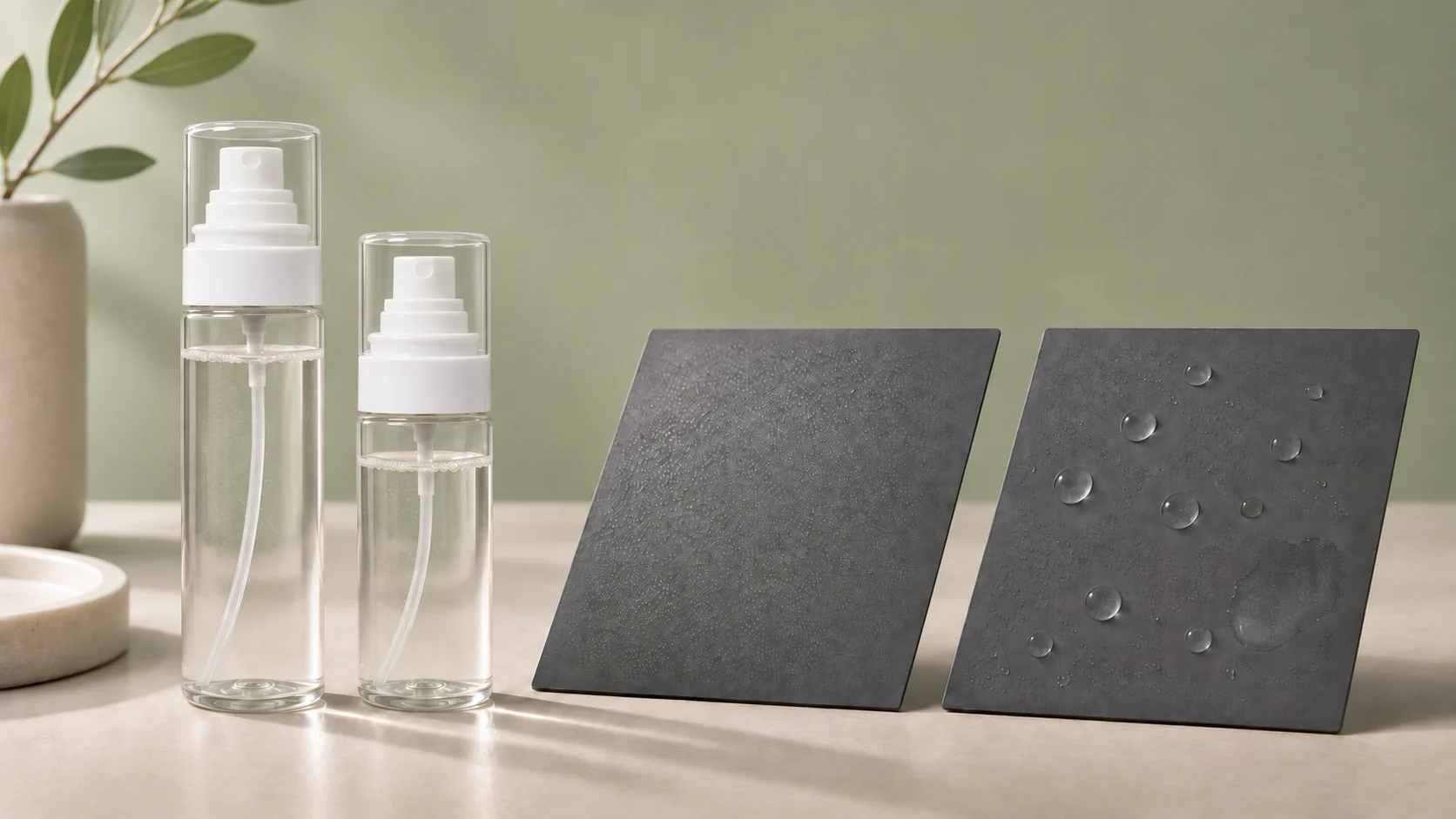
Most sprays can look fine at first. Then a few large drops land in one area, leave a wet patch, and dry unevenly. Before blaming the pump, look at when those drops appear.
Use your finished formula in the actual bottle and pump assembly. A water test can tell you that the pump runs. It will not tell you whether your formula will atomize the same way. That is why a sample that sprays well with water can still leave visible droplets with a setting spray.
When Do the Large Droplets Appear?
If large droplets appear on nearly every press, keep the formula the same and compare a different spray insert or pump. Look closely at the wet spot. Is it coming from a visible large droplet, or is too much liquid simply landing in one area? Those are not the same problem, and they may not need the same change.
If the first spray after standing is wet, test that first press before priming the pump again. Check the nozzle for visible residue, then compare the first press with the next two or three. A wet first press after the bottle has been sitting is a different issue from a spray that is uneven throughout use.
If the bottle sputters when it is nearly empty, test the complete assembly at a low fill level. Check whether the dip tube can still draw liquid with the bottle held at the angle used in real life. A sample that works at a comfortable fill level may behave differently near the end.
And if one assembled sample sprays well while another does not, repeat the comparison on more than one sample before approving or rejecting the pump design. One good sample is not enough to prove the assembly is consistent.
Do not assume that a lower output automatically gives a finer mist. Output is the amount dispensed per press. Spray pattern is how that liquid spreads across the target. Compare both. Aptar Beauty’s fine mist pump overview is a useful reference for how pump selection can account for formula type, viscosity, and the intended spray pattern.
How to Compare Pump Samples
Start with the current assembly as your reference. For each candidate, use the same batch of finished formula, the same starting fill level, and the same spray distance. Use full presses and a fresh spot on the test surface for each comparison. Overlapping sprays can hide individual droplets, especially when the problem is only a few large drops.
Starting with an unprimed pump, count how many full presses it takes to produce a steady spray. Once the spray is steady, compare the pattern across samples. Leave the samples unused for the same interval and compare the first spray before pressing again. Repeat the test when each bottle is nearly empty.
Photograph the spray marks under the same lighting. Note whether you see isolated large droplets, a heavily wetted center, gaps in coverage, or liquid left at the nozzle. If you need to compare output, weigh each assembled bottle before and after the same number of full presses, then divide the mass loss by the number of presses. Record the result as mass per press. Converting it to mL requires the formula’s density.
If you want to isolate what changed, ask your supplier for samples that vary one component at a time where possible. For production approval, test the final bottle, pump, and spray insert together.
What Royapak Changed
A Royapak customer reported that their setting spray produced droplets of noticeably different sizes. We revised both the pump mechanism and the spray insert, and the resulting mist was more uniform. The customer now places regular monthly orders for 300,000 packaging sets with Royapak.
If you run into a similar issue, send your supplier a short video showing when it happens. A clip of the first press after standing is more useful than “the mist isn’t fine enough.” It gives the supplier something concrete to compare.
What to Share When Requesting Samples
When you request another sample, share your target fill volume, the current bottle neck finish if you know it, and a brief description of the formula. Include the pump or packaging sample you are using, when the problem appears, and what you want the spray to feel like. If you have measured output or photographed the spray pattern, send those records too.
If you need a complete assembly to evaluate, the RY-1602A makeup setting spray bottle and fine mist pump is available in 50, 60, 80, and 100 mL, with a nominal pump output of 0.13 mL per full press. It is an option to sample with your own formula.
If you are still choosing the bottle and pump, read How to Choose Setting Spray Packaging for Your Formula. When you are ready to compare assemblies, request packaging samples and include the details above.
For a complete packaging option, explore Royapak setting spray packaging, including capacities, a water spray demonstration and sampling steps.